#### NOTE
This is a **community plugin**, an external project maintained by its respective author.
Community plugins are not part of FiftyOne core and may change independently.
Please review each plugin’s documentation and license before use.

# Molmo2 - FiftyOne Model Zoo Integration
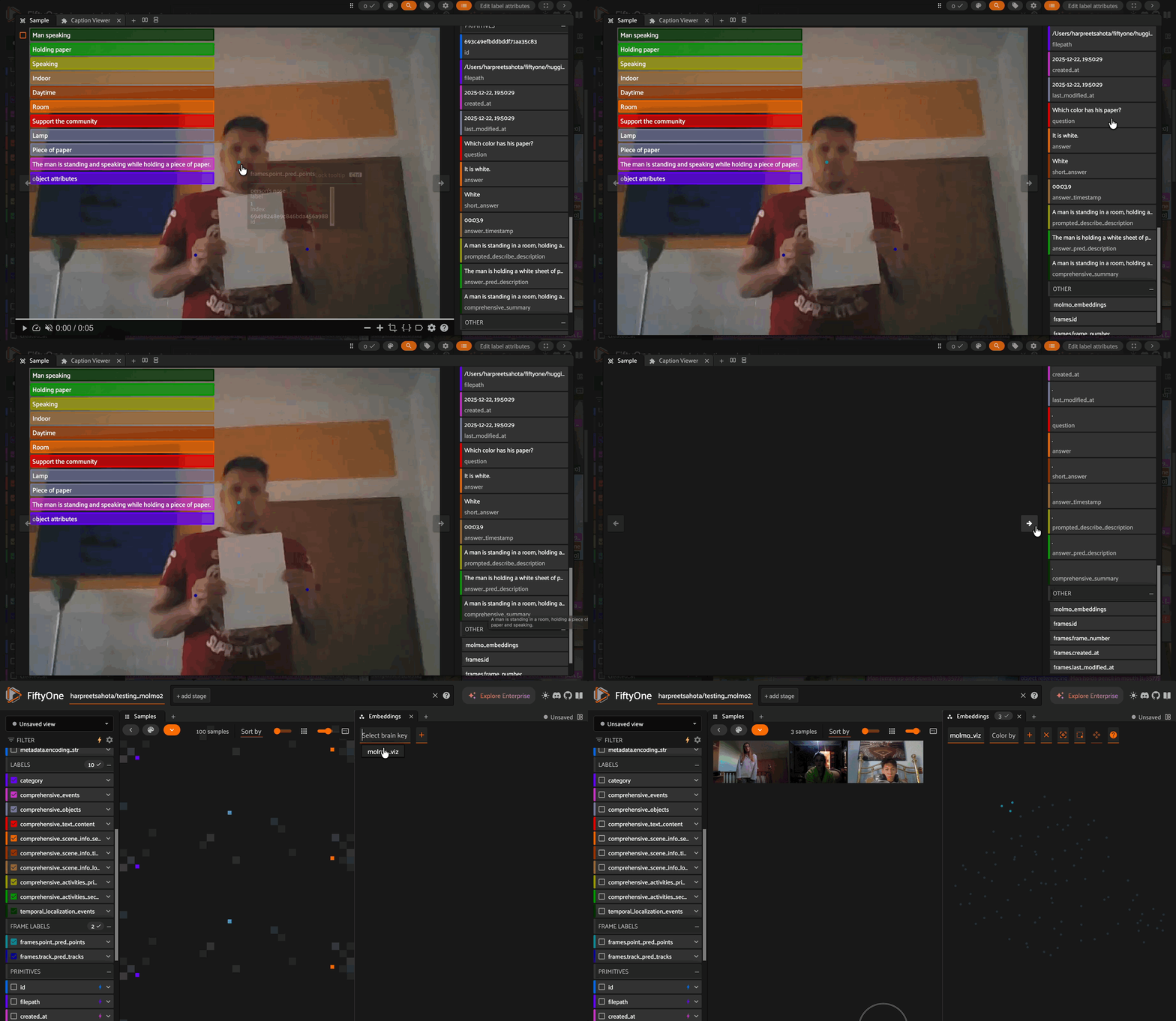 Molmo2 is a family of open vision-language models developed by the Allen Institute for AI (Ai2) that support image, video, and multi-image understanding and grounding. Molmo2 models are trained on publicly available third-party datasets and Molmo2 data, a collection of highly-curated image-text and video-text pairs. It has state-of-the-art performance among multimodal models with similar size.
## Use Cases
Molmo2’s core strength is **grounding** — precise pixel-level localization and tracking over time. While standard models might say “a car passed by,” Molmo2 can point to the **exact car**, follow it **through a crowd**, and mark the **exact second** it crossed a line.
| Domain | Applications |
|---------------------------|----------------------------------------------------------------------------------------------------------------------|
| **Robotics & Automation** | Spatial affordance prediction, action counting (“How many times did the robot grasp the block?”), event localization |
| **Autonomous Driving** | Vehicle tracking, traffic monitoring, pedestrian detection through occlusions |
| **Sports Analytics** | Athlete tracking, action spotting (goals, fouls), multi-player trajectory analysis |
| **Document & Business** | Chart/table understanding, multi-image reasoning for policy analysis, administrative workflow automation |
| **Media & Accessibility** | Dense video captioning (924 words avg), video search metadata, assistive narration for visually impaired |
| **Generative AI QA** | Localizing visual artifacts in AI-generated videos (vanishing subjects, physical incongruities) |
## Model Checkpoints
| Model | Base LLM | Vision Backbone | Notes |
|--------------------------------|-------------------|-------------------|--------------------------------------------------------------------------|
| `allenai/Molmo2-O-7B` | Olmo3-7B-Instruct | SigLIP 2 | Outperforms others on short videos, counting, and captioning |
| `allenai/Molmo2-4B` | Qwen3-4B-Instruct | SigLIP 2 | Compact model with competitive performance |
| `allenai/Molmo2-8B` | Qwen3-8B | SigLIP 2 | Balanced size and performance |
| `allenai/Molmo2-VideoPoint-4B` | Qwen3-4B-Instruct | SigLIP 2 | Finetuned on Molmo2-VideoPoint data only for video pointing and counting |
All models are competitive on long-videos.
## Installation
**Important:** Requires `transformers==4.57.1`
```bash
pip install transformers==4.57.1
```
```bash
pip install fiftyone umap-learn
```
```bash
pip install einops accelerate decord2 molmo_utils
```
## Usage
### Load a Dataset
```python
import fiftyone as fo
from fiftyone.utils.huggingface import load_from_hub
dataset = load_from_hub(
"Voxel51/qualcomm-interactive-video-dataset",
max_samples=20,
overwrite=True
)
# REQUIRED: Compute metadata (needed for timestamp-to-frame conversion)
dataset.compute_metadata()
```
### Load the Model
```python
import fiftyone.zoo as foz
model = foz.load_zoo_model("allenai/Molmo2-4B")
```
### Operations
| Operation | Prompt Template | Output Field Type |
|-------------------------|--------------------------------------|-------------------------------------------------------|
| `pointing` | `"Point to the {prompt}."` | Frame-level `fo.Keypoints` |
| `tracking` | `"Track the {prompt}."` | Frame-level `fo.Keypoints` with `fo.Instance` linking |
| `describe` | Uses prompt directly | Sample-level string |
| `temporal_localization` | Fixed prompt (finds activity events) | Sample-level `fo.TemporalDetections` |
| `comprehensive` | Fixed prompt (full video analysis) | Sample-level mixed (see below) |
### Output Fields by Operation
**pointing / tracking:**
- Frame-level `fo.Keypoints` stored on each frame
- Each keypoint has `label`, `points` (normalized x, y), and `index` (object ID)
- For tracking, keypoints share `fo.Instance` objects to link across frames
**describe:**
- Sample-level string field containing the model’s text response
**temporal_localization:**
- Sample-level `fo.TemporalDetections` with `start`/`end` frame numbers and event descriptions
**comprehensive:**
- `summary`: Sample-level string
- `events`: `fo.TemporalDetections`
- `objects`: `fo.TemporalDetections` (with first/last appearance times)
- `text_content`: `fo.TemporalDetections` (for any text detected in video)
- `scene_info_*`: `fo.Classification` fields (setting, time_of_day, location_type)
- `activities_*`: `fo.Classification` or `fo.Classifications` fields
### Embeddings
Generate fixed-dimension vector embeddings for each video. Useful for similarity search, clustering, and visualization.
**Added field:** `molmo_embeddings` — a numpy array of shape `(hidden_dim,)` on each sample.
**Pooling strategy:** Controls how variable-length hidden states are collapsed into a fixed-size vector:
- `mean` (default) — average across all tokens
- `max` — max pooling across tokens
- `cls` — use the first (CLS) token only
```python
model.pooling_strategy = "mean" # or "max" or "cls"
dataset.compute_embeddings(
model,
batch_size=8,
num_workers=2,
embeddings_field="molmo_embeddings",
skip_failures=False
)
```
### Visualize Embeddings
Use FiftyOne Brain to project embeddings into 2D/3D for visualization in the App.
```python
import fiftyone.brain as fob
results = fob.compute_visualization(
dataset,
method="umap", # Also supports "tsne", "pca"
brain_key="molmo_viz",
embeddings="molmo_embeddings",
num_dims=2 # or 3 for 3D
)
```
### Describe
Generate free-form text descriptions, captions, or answers to questions about videos. The prompt is used directly without any template.
**Added field:** A string field (e.g., `prompted_describe` or `answer_pred`) containing the model’s text response on each sample.
```python
# With a global prompt
model.operation = "describe"
model.prompt = "Provide a short description for what is happening in the video"
dataset.apply_model(
model,
"prompted_describe",
batch_size=16,
num_workers=4,
skip_failures=False
)
# With per-sample prompts from a field (e.g., for VQA)
model.operation = "describe"
dataset.apply_model(
model,
prompt_field="question",
label_field="answer_pred",
batch_size=16,
num_workers=1,
skip_failures=False
)
```
### Pointing
Point to objects in video frames. The model identifies where instances of the specified object appear across frames and returns their coordinates.
**Added field:** Frame-level `fo.Keypoints` on each frame where the object is detected. Each keypoint contains normalized `(x, y)` coordinates and an `index` identifying the object instance.
> **Tip:** If pointing/counting is your primary use case, consider using `allenai/Molmo2-VideoPoint-4B` which is specifically finetuned for video pointing and counting tasks.
```python
model.operation = "pointing"
model.prompt = "person's nose"
dataset.apply_model(
model,
"point_pred",
batch_size=16,
num_workers=1,
skip_failures=False
)
```
### Tracking
Track objects across video frames. Similar to pointing, but keypoints for the same object share an `fo.Instance` to link them across time.
**Added field:** Frame-level `fo.Keypoints` with `fo.Instance` linking. Objects maintain consistent identity across frames, enabling trajectory analysis.
```python
model.operation = "tracking"
model.prompt = "person's hand"
dataset.apply_model(
model,
"track_pred",
batch_size=16,
num_workers=1,
skip_failures=False
)
```
### Comprehensive
Run a full video analysis that extracts multiple types of information: summary, events, objects, text content, scene info, and activities.
**Added fields:** Multiple fields are added to each sample:
- `comprehensive_summary` — text description
- `comprehensive_events` — `fo.TemporalDetections` for activities/events
- `comprehensive_objects` — `fo.TemporalDetections` with first/last appearance times
- `comprehensive_scene_info_*` — `fo.Classification` fields (setting, time_of_day, location_type)
- `comprehensive_activities_*` — `fo.Classification` or `fo.Classifications`
```python
model.operation = "comprehensive"
dataset.apply_model(
model,
"comprehensive",
batch_size=2,
num_workers=1,
skip_failures=False
)
```
### Temporal Localization
Find and localize activity events in the video with start/end timestamps.
**Added field:** `fo.TemporalDetections` on each sample containing detected events with their time intervals and descriptions.
```python
model.operation = "temporal_localization"
dataset.apply_model(
model,
"temporal_localization",
batch_size=2,
num_workers=1,
skip_failures=False
)
```
### Launch the App
```python
session = fo.launch_app(dataset, auto=False)
```
## Citation
If you use Molmo2 in your research, please cite the [technical report](https://www.datocms-assets.com/64837/1765901660-molmo_v2_2026-techreport-3.pdf):
```bibtex
@techreport{molmo2,
title={Molmo2: Open Weights and Data for Vision-Language Models with Video Understanding and Grounding},
author={Clark, Christopher and Zhang, Jieyu and Ma, Zixian and Park, Jae Sung and Salehi, Mohammadreza and Tripathi, Rohun and Lee, Sangho and Ren, Zhongzheng and Kim, Chris Dongjoo and Yang, Yinuo and Shao, Vincent and Yang, Yue and Huang, Weikai and Gao, Ziqi and Anderson, Taira and Zhang, Jianrui and Jain, Jitesh and Stoica, George and Han, Winston and Farhadi, Ali and Krishna, Ranjay},
institution={Allen Institute for AI},
year={2025}
}
```
Molmo2 is a family of open vision-language models developed by the Allen Institute for AI (Ai2) that support image, video, and multi-image understanding and grounding. Molmo2 models are trained on publicly available third-party datasets and Molmo2 data, a collection of highly-curated image-text and video-text pairs. It has state-of-the-art performance among multimodal models with similar size.
## Use Cases
Molmo2’s core strength is **grounding** — precise pixel-level localization and tracking over time. While standard models might say “a car passed by,” Molmo2 can point to the **exact car**, follow it **through a crowd**, and mark the **exact second** it crossed a line.
| Domain | Applications |
|---------------------------|----------------------------------------------------------------------------------------------------------------------|
| **Robotics & Automation** | Spatial affordance prediction, action counting (“How many times did the robot grasp the block?”), event localization |
| **Autonomous Driving** | Vehicle tracking, traffic monitoring, pedestrian detection through occlusions |
| **Sports Analytics** | Athlete tracking, action spotting (goals, fouls), multi-player trajectory analysis |
| **Document & Business** | Chart/table understanding, multi-image reasoning for policy analysis, administrative workflow automation |
| **Media & Accessibility** | Dense video captioning (924 words avg), video search metadata, assistive narration for visually impaired |
| **Generative AI QA** | Localizing visual artifacts in AI-generated videos (vanishing subjects, physical incongruities) |
## Model Checkpoints
| Model | Base LLM | Vision Backbone | Notes |
|--------------------------------|-------------------|-------------------|--------------------------------------------------------------------------|
| `allenai/Molmo2-O-7B` | Olmo3-7B-Instruct | SigLIP 2 | Outperforms others on short videos, counting, and captioning |
| `allenai/Molmo2-4B` | Qwen3-4B-Instruct | SigLIP 2 | Compact model with competitive performance |
| `allenai/Molmo2-8B` | Qwen3-8B | SigLIP 2 | Balanced size and performance |
| `allenai/Molmo2-VideoPoint-4B` | Qwen3-4B-Instruct | SigLIP 2 | Finetuned on Molmo2-VideoPoint data only for video pointing and counting |
All models are competitive on long-videos.
## Installation
**Important:** Requires `transformers==4.57.1`
```bash
pip install transformers==4.57.1
```
```bash
pip install fiftyone umap-learn
```
```bash
pip install einops accelerate decord2 molmo_utils
```
## Usage
### Load a Dataset
```python
import fiftyone as fo
from fiftyone.utils.huggingface import load_from_hub
dataset = load_from_hub(
"Voxel51/qualcomm-interactive-video-dataset",
max_samples=20,
overwrite=True
)
# REQUIRED: Compute metadata (needed for timestamp-to-frame conversion)
dataset.compute_metadata()
```
### Load the Model
```python
import fiftyone.zoo as foz
model = foz.load_zoo_model("allenai/Molmo2-4B")
```
### Operations
| Operation | Prompt Template | Output Field Type |
|-------------------------|--------------------------------------|-------------------------------------------------------|
| `pointing` | `"Point to the {prompt}."` | Frame-level `fo.Keypoints` |
| `tracking` | `"Track the {prompt}."` | Frame-level `fo.Keypoints` with `fo.Instance` linking |
| `describe` | Uses prompt directly | Sample-level string |
| `temporal_localization` | Fixed prompt (finds activity events) | Sample-level `fo.TemporalDetections` |
| `comprehensive` | Fixed prompt (full video analysis) | Sample-level mixed (see below) |
### Output Fields by Operation
**pointing / tracking:**
- Frame-level `fo.Keypoints` stored on each frame
- Each keypoint has `label`, `points` (normalized x, y), and `index` (object ID)
- For tracking, keypoints share `fo.Instance` objects to link across frames
**describe:**
- Sample-level string field containing the model’s text response
**temporal_localization:**
- Sample-level `fo.TemporalDetections` with `start`/`end` frame numbers and event descriptions
**comprehensive:**
- `summary`: Sample-level string
- `events`: `fo.TemporalDetections`
- `objects`: `fo.TemporalDetections` (with first/last appearance times)
- `text_content`: `fo.TemporalDetections` (for any text detected in video)
- `scene_info_*`: `fo.Classification` fields (setting, time_of_day, location_type)
- `activities_*`: `fo.Classification` or `fo.Classifications` fields
### Embeddings
Generate fixed-dimension vector embeddings for each video. Useful for similarity search, clustering, and visualization.
**Added field:** `molmo_embeddings` — a numpy array of shape `(hidden_dim,)` on each sample.
**Pooling strategy:** Controls how variable-length hidden states are collapsed into a fixed-size vector:
- `mean` (default) — average across all tokens
- `max` — max pooling across tokens
- `cls` — use the first (CLS) token only
```python
model.pooling_strategy = "mean" # or "max" or "cls"
dataset.compute_embeddings(
model,
batch_size=8,
num_workers=2,
embeddings_field="molmo_embeddings",
skip_failures=False
)
```
### Visualize Embeddings
Use FiftyOne Brain to project embeddings into 2D/3D for visualization in the App.
```python
import fiftyone.brain as fob
results = fob.compute_visualization(
dataset,
method="umap", # Also supports "tsne", "pca"
brain_key="molmo_viz",
embeddings="molmo_embeddings",
num_dims=2 # or 3 for 3D
)
```
### Describe
Generate free-form text descriptions, captions, or answers to questions about videos. The prompt is used directly without any template.
**Added field:** A string field (e.g., `prompted_describe` or `answer_pred`) containing the model’s text response on each sample.
```python
# With a global prompt
model.operation = "describe"
model.prompt = "Provide a short description for what is happening in the video"
dataset.apply_model(
model,
"prompted_describe",
batch_size=16,
num_workers=4,
skip_failures=False
)
# With per-sample prompts from a field (e.g., for VQA)
model.operation = "describe"
dataset.apply_model(
model,
prompt_field="question",
label_field="answer_pred",
batch_size=16,
num_workers=1,
skip_failures=False
)
```
### Pointing
Point to objects in video frames. The model identifies where instances of the specified object appear across frames and returns their coordinates.
**Added field:** Frame-level `fo.Keypoints` on each frame where the object is detected. Each keypoint contains normalized `(x, y)` coordinates and an `index` identifying the object instance.
> **Tip:** If pointing/counting is your primary use case, consider using `allenai/Molmo2-VideoPoint-4B` which is specifically finetuned for video pointing and counting tasks.
```python
model.operation = "pointing"
model.prompt = "person's nose"
dataset.apply_model(
model,
"point_pred",
batch_size=16,
num_workers=1,
skip_failures=False
)
```
### Tracking
Track objects across video frames. Similar to pointing, but keypoints for the same object share an `fo.Instance` to link them across time.
**Added field:** Frame-level `fo.Keypoints` with `fo.Instance` linking. Objects maintain consistent identity across frames, enabling trajectory analysis.
```python
model.operation = "tracking"
model.prompt = "person's hand"
dataset.apply_model(
model,
"track_pred",
batch_size=16,
num_workers=1,
skip_failures=False
)
```
### Comprehensive
Run a full video analysis that extracts multiple types of information: summary, events, objects, text content, scene info, and activities.
**Added fields:** Multiple fields are added to each sample:
- `comprehensive_summary` — text description
- `comprehensive_events` — `fo.TemporalDetections` for activities/events
- `comprehensive_objects` — `fo.TemporalDetections` with first/last appearance times
- `comprehensive_scene_info_*` — `fo.Classification` fields (setting, time_of_day, location_type)
- `comprehensive_activities_*` — `fo.Classification` or `fo.Classifications`
```python
model.operation = "comprehensive"
dataset.apply_model(
model,
"comprehensive",
batch_size=2,
num_workers=1,
skip_failures=False
)
```
### Temporal Localization
Find and localize activity events in the video with start/end timestamps.
**Added field:** `fo.TemporalDetections` on each sample containing detected events with their time intervals and descriptions.
```python
model.operation = "temporal_localization"
dataset.apply_model(
model,
"temporal_localization",
batch_size=2,
num_workers=1,
skip_failures=False
)
```
### Launch the App
```python
session = fo.launch_app(dataset, auto=False)
```
## Citation
If you use Molmo2 in your research, please cite the [technical report](https://www.datocms-assets.com/64837/1765901660-molmo_v2_2026-techreport-3.pdf):
```bibtex
@techreport{molmo2,
title={Molmo2: Open Weights and Data for Vision-Language Models with Video Understanding and Grounding},
author={Clark, Christopher and Zhang, Jieyu and Ma, Zixian and Park, Jae Sung and Salehi, Mohammadreza and Tripathi, Rohun and Lee, Sangho and Ren, Zhongzheng and Kim, Chris Dongjoo and Yang, Yinuo and Shao, Vincent and Yang, Yue and Huang, Weikai and Gao, Ziqi and Anderson, Taira and Zhang, Jianrui and Jain, Jitesh and Stoica, George and Han, Winston and Farhadi, Ali and Krishna, Ranjay},
institution={Allen Institute for AI},
year={2025}
}
```