<table class="fo-notebook-links" align="left">
    <td>
        <a target="_blank" href="https://colab.research.google.com/github/voxel51/fiftyone/blob/main/docs/source/getting_started/manufacturing/02_embeddings.ipynb">
            <img src="https://cdn.voxel51.com/colab-logo-256px.png"> &nbsp; Run in Google Colab
        </a>
    </td>
    <td>
        <a target="_blank" href="https://github.com/voxel51/fiftyone/blob/main/docs/source/getting_started/manufacturing/02_embeddings.ipynb">
            <img src="https://cdn.voxel51.com/github-logo-256px.png"> &nbsp; View source on GitHub
        </a>
    </td>
    <td>
        <a target="_blank" href="https://raw.githubusercontent.com/voxel51/fiftyone/main/docs/source/getting_started/manufacturing/02_embeddings.ipynb" download>
            <img src="https://cdn.voxel51.com/cloud-icon-256px.png"> &nbsp; Download notebook
        </a>
    </td>
</table>

# Understanding and Using Embeddings

Welcome to this hands-on workshop where we will explore **embeddings** and their importance in Visual AI. Embeddings play a crucial role in **image search, clustering, anomaly detection, and representation learning**. In this notebook, we will learn how to generate, visualize, and explore embeddings using **FiftyOne**.

![using_embeddings](https://cdn.voxel51.com/getting_started_manufacturing/notebook2/using_embeddings.webp)

## Learning Objectives:

- Understand what embeddings are and why they matter in Visual AI.
- Learn how to compute and store embeddings in FiftyOne.
- Use embeddings for similarity search and visualization.
- Leverage FiftyOne’s interactive tools to explore embeddings.

## What Are Embeddings?

Embeddings are **vector representations** of data (images, videos, text, etc.) that capture meaningful characteristics. For images, embeddings store compressed feature representations learned by deep learning models. These features enable tasks such as:

- **Similarity Search**: Find images that are visually similar.
- **Clustering**: Group images with shared characteristics.
- **Anomaly Detection**: Identify outliers in datasets.
- **Transfer Learning**: Use learned embeddings to improve other AI tasks.

### Further Reading:

- [Introduction to Embeddings](https://www.tensorflow.org/text/guide/word_embeddings)
- [Feature Representations in Deep Learning](https://pytorch.org/tutorials/beginner/nlp/word_embeddings_tutorial.html)

## Generating Embeddings in FiftyOne

FiftyOne provides seamless integration for embedding computation. You can extract embeddings using pre-trained deep learning models (such as CLIP, ResNet, or custom models) and store them in FiftyOne datasets.

### How It Works:

1. Load a dataset in FiftyOne.
2. Extract embeddings from a model.
3. Store and visualize embeddings.

**Relevant Documentation:** [Computing and Storing Embeddings](https://voxel51.com/docs/fiftyone/user_guide/brain.html#computing-embeddings)

<div style="border-left: 4px solid #3498db; padding: 6px;">

Note: You must install the `umap-learn>=0.5` package in order to use UMAP-based visualization. This is recommended, as UMAP is awesome! If you do not wish to install UMAP, try `method='tsne'` instead

Select a GPU Runtime if possible, install the requirements, restart the session, and verify the device information.

# Download dataset from source

We can download the file from Google Drive using `gdown`

Let’s get started by importing the FiftyOne library, and the utils we need for a COCO format dataset, depending of the dataset format you should change that option. [Supported Formats](https://docs.voxel51.com/user_guide/dataset_creation/datasets.html#supported-formats)

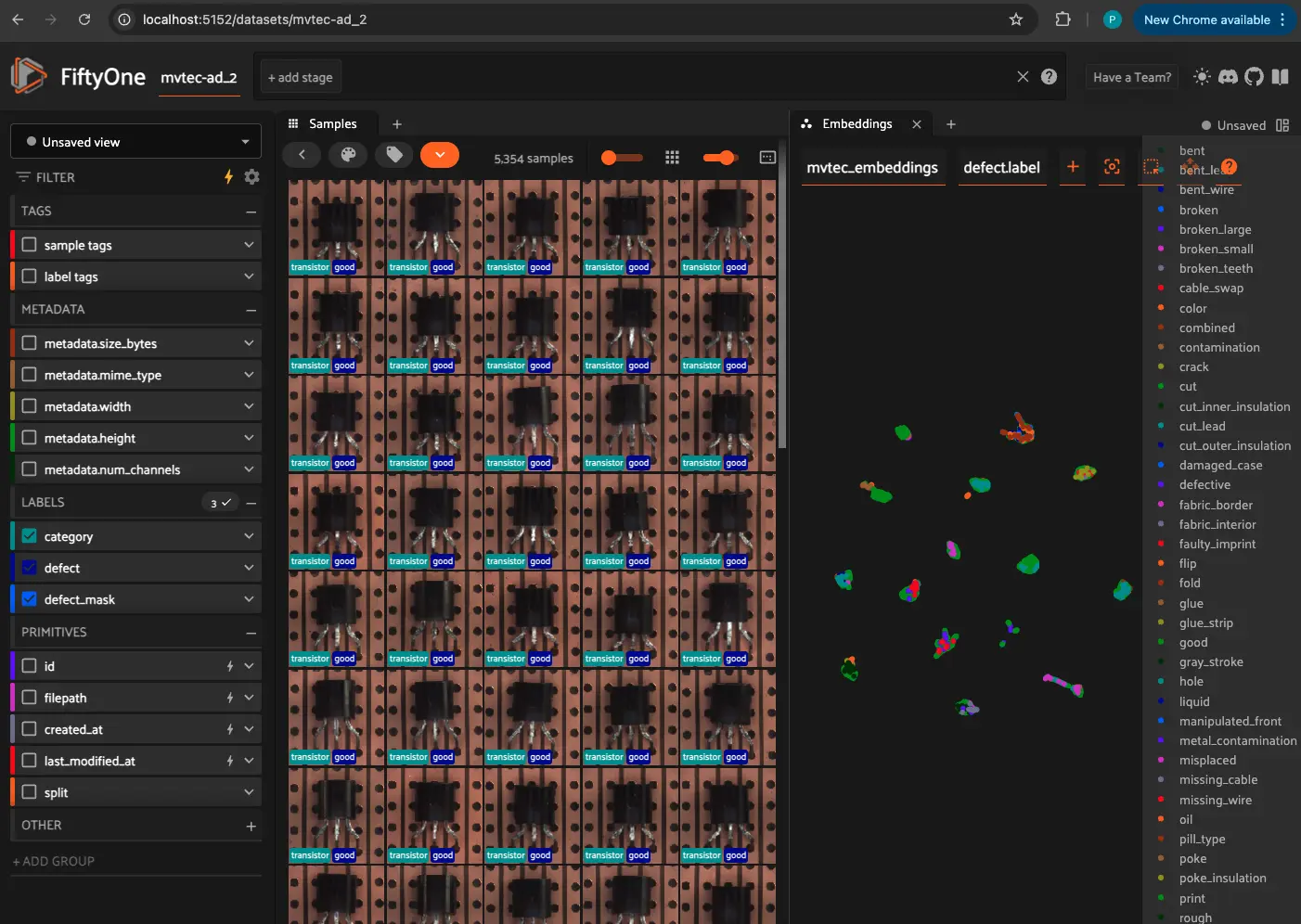
## Exploring and Visualizing Embeddings

Once embeddings are generated, we can visualize them using **dimensionality reduction techniques** like:

- **t-SNE (t-Distributed Stochastic Neighbor Embedding)**
- **UMAP (Uniform Manifold Approximation and Projection)**

These methods reduce the high-dimensional feature space into 2D/3D representations for interactive visualization.

**Relevant Documentation:** [Visualizing Embeddings in FiftyOne](https://docs.voxel51.com/brain.html#visualizing-embeddings), [Dimensionality Reduction](https://docs.voxel51.com/brain.html#visualizing-embeddings)

<div style="border-left: 4px solid #3498db; padding: 6px;">

Note: Be patient, it will take about 5-10 minutes to compute the embeddings.

## Performing Similarity Search with Embeddings

With embeddings, we can search for visually similar images by computing the nearest neighbors in the embedding space. FiftyOne provides built-in tools to perform **similarity search** efficiently.

**Relevant Documentation:** [Performing Similarity Search](https://voxel51.com/docs/fiftyone/user_guide/brain.html#similarity-search)
![similarity](https://cdn.voxel51.com/getting_started_manufacturing/notebook2/similarity.webp)

### Next Steps:

Try using different models for embedding extraction, explore clustering techniques, and test similarity search with your own datasets! 🚀